
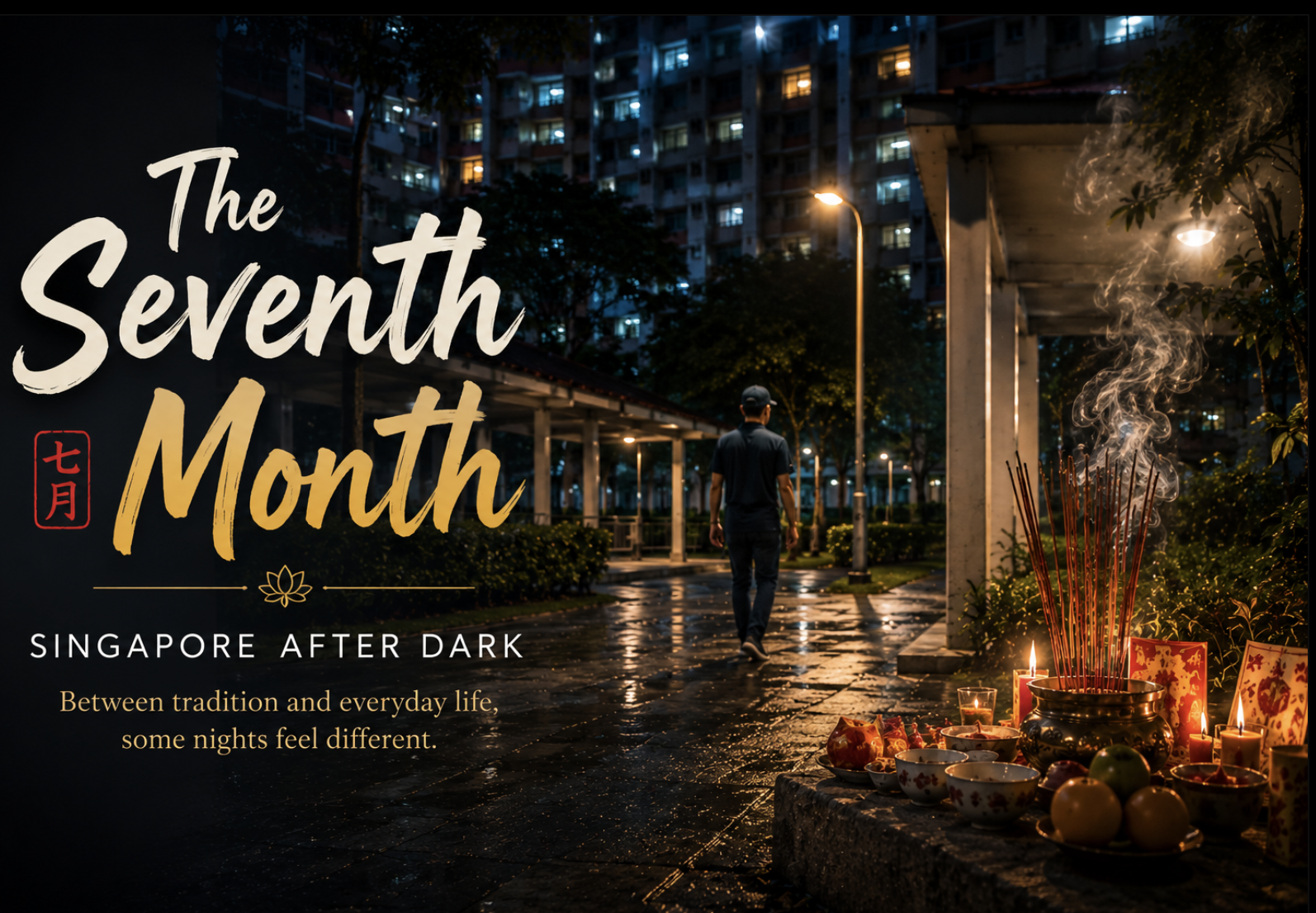
A routine delivery, a wrong lift, two versions of Level Five—and a door that opened when nobody appeared to be there
There is something different about Singapore after dark during the Seventh Lunar Month.
Along housing estates and older neighbourhoods, small fires glow beside the pavement. Incense burns. Offerings sit carefully arranged near trees and designated burners. Occasionally, the smell of smoke drifts between the blocks.
To many Chinese families, this period is traditionally known as the Seventh Month, and the fifteenth lunar day is commonly associated with the Hungry Ghost Festival.
According to traditional folk belief, the boundary between the living and the spirit world is considered less distant during this period.
People leave food and other offerings for wandering spirits and deceased ancestors. Getai performances may be staged, sometimes with the front row deliberately left empty according to popular custom.
There are also countless pieces of advice passed from one generation to another.
Don’t disturb offerings.
Don’t kick or step over them.
Don’t casually call someone’s full name late at night.
Don’t pick up strange objects from the ground.
And if you hear something unusual behind you at night, some versions of the folklore advise against immediately turning around.
Whether someone believes these traditions is personal.
But during the Seventh Month, stories that would normally sound merely strange can suddenly feel a little more unsettling.
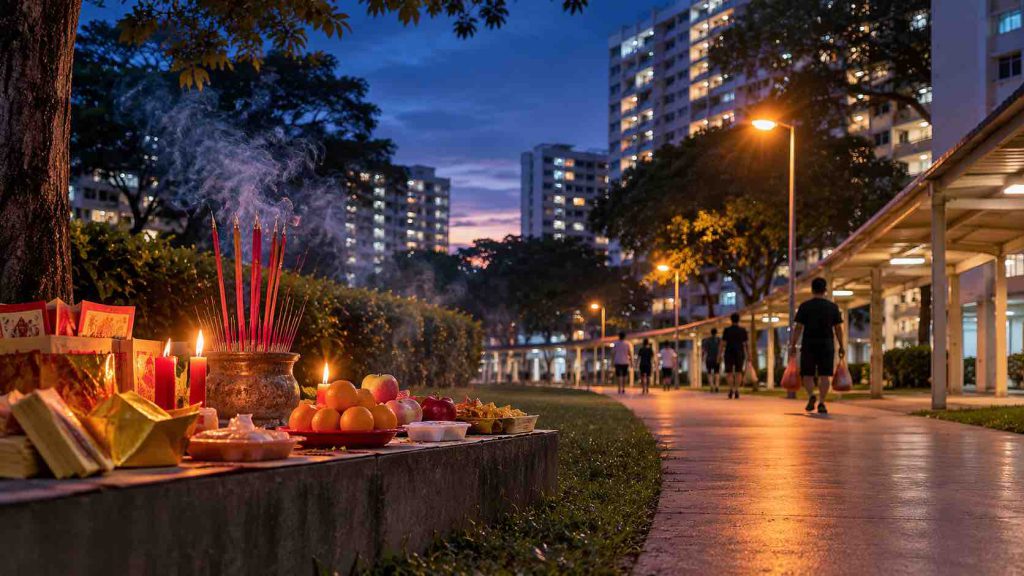
During the Seventh Lunar Month, familiar neighbourhood spaces can take on a very different atmosphere after sunset.
The Traditions Behind the Seventh Month
The Seventh Month is surrounded by traditions that have been passed down through generations.
Offerings may be placed at designated areas. Incense is burned. Families may make offerings in remembrance of ancestors, while other practices are associated with wandering spirits in traditional folk belief.
For someone growing up around these customs, the atmosphere can be immediately recognisable.
The smoke.
The smell of incense.
The glow from burning offerings.
And the occasional reminder from an older relative:
“Don’t disturb that.”
Folklore, Warnings and the Things People Remember
Many of the most memorable Seventh Month traditions aren’t formal rules.
They are the things people tell one another.
Don’t step over offerings.
Don’t take something that doesn’t belong to you.
Be respectful around places where offerings have been placed.
And depending on the family or community, there may be other warnings passed down over the years.
Whether these beliefs are taken literally or understood as cultural folklore, they have one thing in common:
They encourage people to be aware of their surroundings.
Especially after dark.
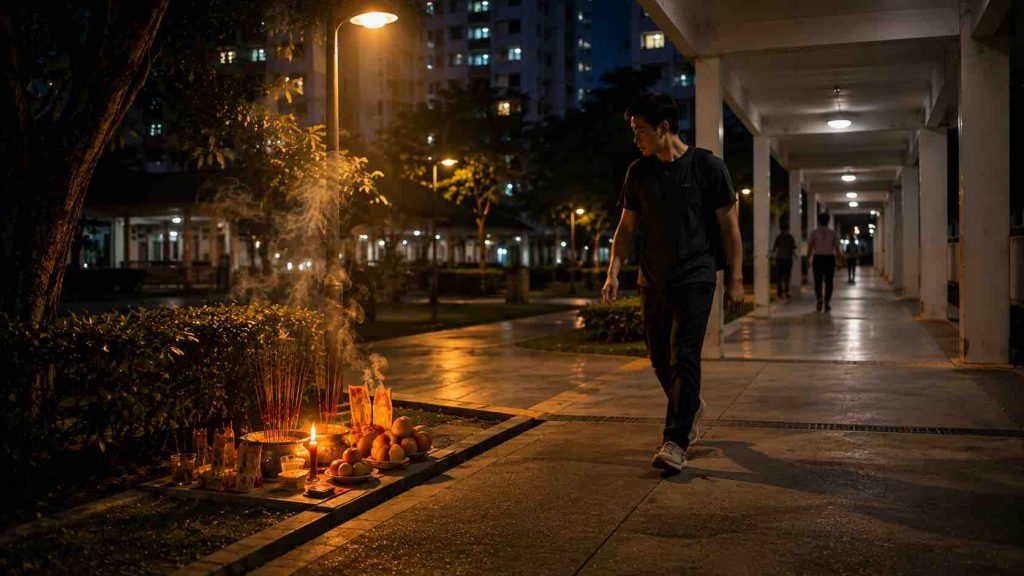
One of the simplest pieces of traditional advice is also one of the most practical: leave offerings undisturbed.
From Folklore to an Ordinary Delivery
Against that background came an experience that had nothing to do with ghost hunting.
Nobody was searching for something supernatural.
Nobody entered an abandoned building.
Nobody deliberately challenged a Seventh Month taboo.
It began with something far more ordinary:
a delivery.
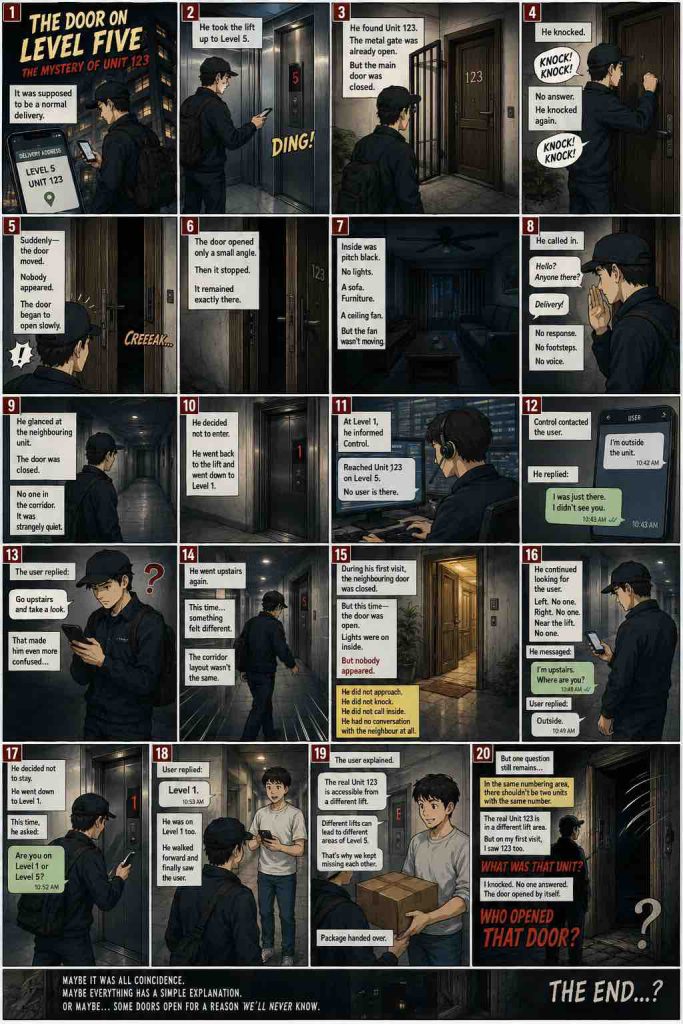
A delivery address appeared on a phone.
Level 5. Unit 123.
A building.
A lift.
A package.
And a destination that should have taken only a few minutes to reach.
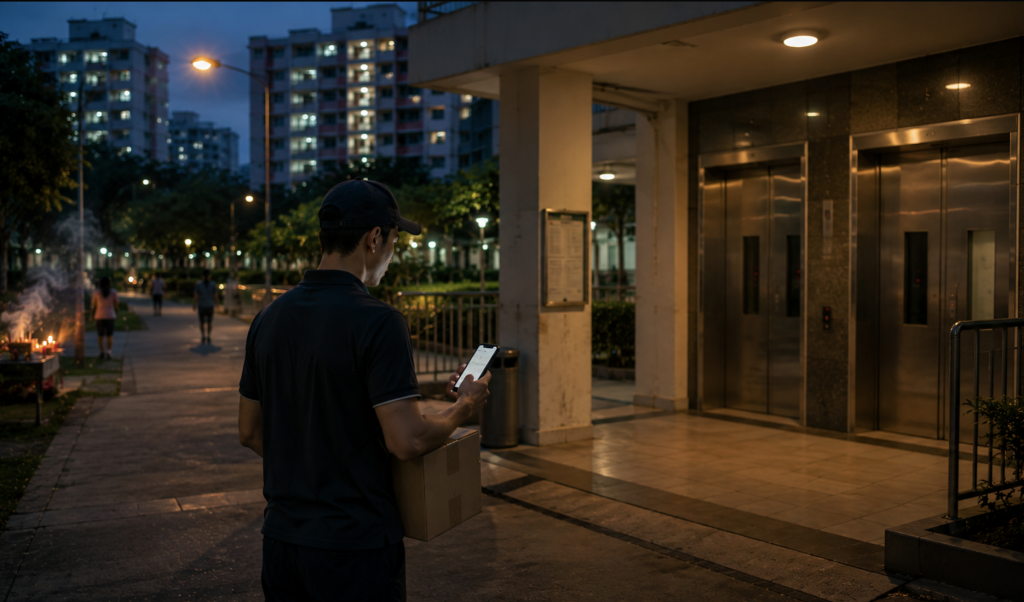
Nothing about the assignment suggested it would become memorable: one parcel, one address, one residential building.
A Normal Delivery
The address on the phone read:
Level 5. Unit 123.
The delivery worker arrived at the building and found a lift.
There was no reason to think it was the wrong one.
He entered, pressed 5, and waited.
The lift climbed.
Then came the familiar sound.
Ding.
The doors opened.
Outside was a residential corridor.
It was quiet.
Very quiet.
He walked along the corridor, checking the unit numbers until he found what appeared to be the correct address.
123.
The outer metal gate was already open.
The main wooden door behind it was closed.
He stopped outside and knocked.
Knock. Knock.
Nothing.
He waited.
Then knocked again.
Knock. Knock.
Still nothing.
And then the door moved.
The Door Opened
There was no sudden movement.
No dramatic bang.
That was perhaps what made it stranger.
The wooden door simply began opening.
Slowly.
A little at a time.
There was no visible hand on the door.
Nobody stepped forward to greet him.
The opening gradually became wide enough to see part of the apartment.
Then the door stopped.
It remained open at only a small angle.
The delivery worker waited.
Nobody appeared.
He stayed outside.
Through the narrow opening, he could make out the interior.
It was dark.
None of the lights appeared to be on.
There was a sofa.
Furniture.
White surfaces were faintly visible in the darkness.
Above them was a ceiling fan.
It wasn’t moving.
Nothing seemed to be moving.
The entire room looked completely still.
He called out.
“Hello?”
No response.
“Delivery!”
Nothing.
No footsteps approached the entrance.
Nobody answered from another room.
The door remained exactly where it had stopped.
The Closed Door Next Door
The delivery worker looked towards the neighbouring unit.
Its door was closed.
There was nobody standing outside.
Nobody appeared elsewhere along the corridor either.
The floor seemed deserted.
There could, of course, have been a perfectly ordinary explanation.
Someone inside Unit 123 might have opened the door and walked away before becoming visible.
The door might not have been properly latched.
Air pressure can move doors.
Someone might have heard the knocking but simply chosen not to respond.
But the delivery worker had no reason to investigate.
Entering a stranger’s home was out of the question.
So he left.
He returned to the lift and went down to Level 1.
“I’m Outside the Unit.”
At Level 1, Control was informed.
The message was straightforward:
The delivery worker had reached Unit 123 on Level 5, but nobody was there to receive the delivery.
Control contacted the user.
Then came an unexpected reply.
“I’m outside the unit.”
That didn’t make sense.
The delivery worker had just been outside the unit.
He had seen nobody.
He replied that he had already been upstairs and couldn’t see the user.
The response was effectively:
Go upstairs and take another look.
Now the situation became confusing.
If the user was outside Unit 123, and the delivery worker had just been standing outside Unit 123, how could they possibly have missed each other?
There was only one obvious thing to do.
Go back to Level Five.
The Second Trip to Level Five
The delivery worker entered the lift again.
He pressed:
5.
The lift climbed.
Ding.
The doors opened.
He stepped outside.
And something immediately seemed different.
The corridor didn’t look quite like the corridor he remembered.
It wasn’t necessarily one dramatic difference.
Rather, the overall layout seemed wrong.
The positioning of the walls.
The distance between the units.
The way the corridor extended from the lift.
He had only been there minutes earlier.
Yet now he found himself thinking:
Was this really the same place?
Then he noticed the neighbouring unit.
This Time, the Neighbour’s Door Was Open
On the first visit, the neighbouring unit’s door had been closed.
Now—
it was open.
There was another difference.
The lights inside were on.
Warm light came through the open doorway and reached into the corridor.
But nobody was standing there.
No neighbour came outside.
The delivery worker did not approach the neighbour.
He didn’t knock.
He didn’t call into the apartment.
He didn’t speak to anyone there.
There was no conversation with the neighbour at all.
It was simply something he noticed while searching for the user.
First visit:
Neighbour’s door closed.
Second visit:
Neighbour’s door open. Lights on.
But on both visits:
No neighbour appeared.
The delivery worker continued searching.
“Outside.”
He looked around the corridor.
Nobody.
Near the lift?
Nobody.
Near the unit?
Nobody.
He messaged the user.
“I’m upstairs. Where are you?”
The response came back:
“Outside.”
He looked up from his phone.
The corridor was empty.
The user said they were outside.
The delivery worker was outside.
Yet they still couldn’t see each other.
At this point, remaining on Level Five wasn’t solving anything.
So he went downstairs again.
One Very Specific Question
Back on Level 1, the delivery worker changed his question.
Instead of asking:
“Where are you?”
he asked:
“Are you on Level 1 or Level 5?”
The reply arrived.
“Level 1.”
There was now another surprise.
The delivery worker was also on Level 1.
He walked further through the ground-floor area.
And finally—
he saw the user.
For the first time since arriving at the building, both people were actually standing in the same place.
The explanation followed.
There Was Another Lift
The actual Unit 123 was accessed using a different lift.
The building had separate lift-access areas.
Two lifts could take people to the same numbered floor while serving different parts of the building.
Suddenly, much of the confusion made sense.
The delivery worker had been using one lift.
The user had been referring to an area served by another.
Both could truthfully say:
“I’m outside.”
But they weren’t outside the same place.
The delivery was handed over at Level 1.
Job completed.
Mystery solved.
Or at least—
most of it was solved.
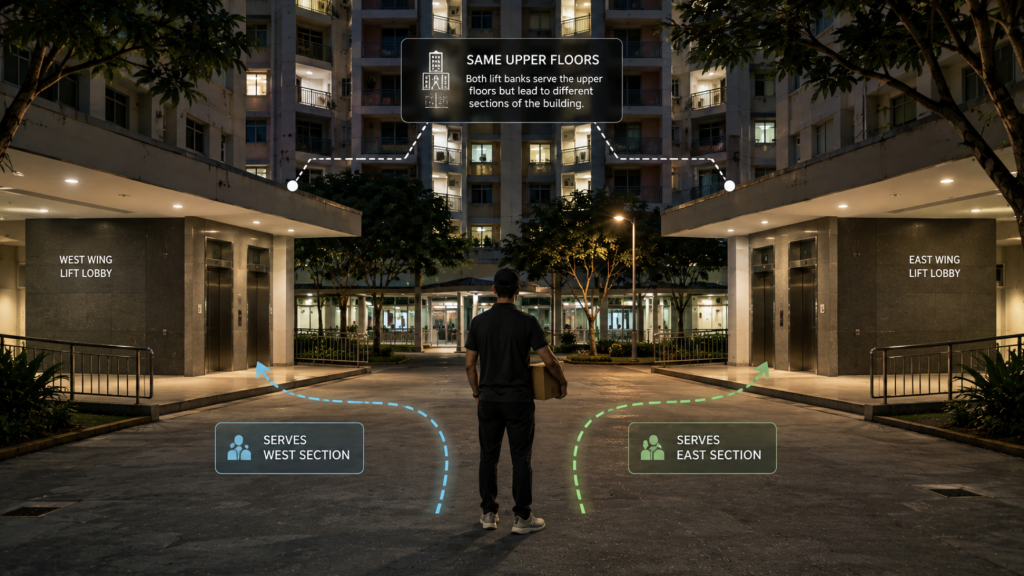
The practical explanation was surprisingly simple: the building had another lift serving a different section.
The Other Unit 123
There was still something uncomfortable about the experience.
The different lifts explained why the delivery worker couldn’t find the user.
They could potentially explain why the corridors seemed different.
Large or complicated buildings can have separate wings, lift cores and access routes.
But there was another question.
A common assumption about residential numbering is that within the same numbering system or area, two different homes shouldn’t normally carry exactly the same complete unit identifier.
That isn’t a supernatural rule, and building numbering can certainly be more complicated than it first appears.
But it creates an interesting question in this story.
The delivery worker remembered seeing:
123
during the first visit.
That was why he knocked on that particular door.
Yet the real Unit 123 apparently required another lift.
So what exactly had he found the first time?
Perhaps he simply misread the number.
Perhaps the building used a numbering system he didn’t understand.
Perhaps the two lift zones made the unit identifiers appear more similar than they actually were.
There are plenty of ordinary possibilities.
But then there was still the door.
Coincidence, Architecture—or Something Else?
There is no evidence that anything supernatural happened.
In fact, there are reasonable explanations for almost every part of the experience.
A pressure difference could move an improperly latched door.
Someone inside might have opened it without coming to the entrance.
The delivery worker’s memory of the first corridor could have been imperfect.
The neighbour’s open door and illuminated apartment during the second visit could have been entirely normal.
The unit-number mystery could simply come down to an unfamiliar building layout.
And the main confusion definitely had at least one practical explanation:
there was another lift.
But mysteries don’t always come from something being impossible.
Sometimes they come from several ordinary events happening in exactly the right sequence to make an experience feel impossible.
During the Seventh Month, that feeling becomes even harder to ignore.
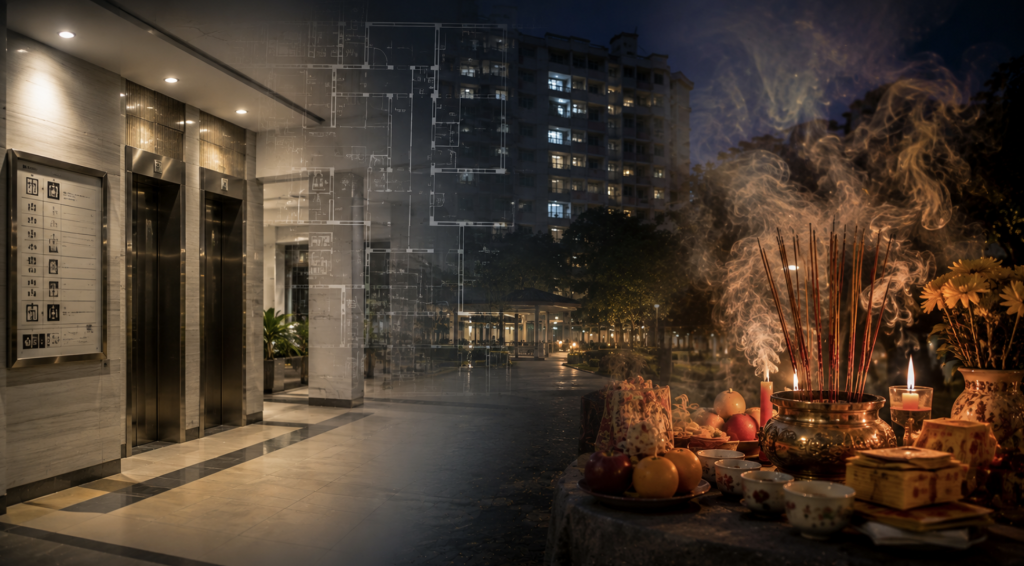
Architecture can explain the route. Folklore changes how we interpret what remains unexplained.
The Seventh Month Connection
Traditional Seventh Month beliefs would inevitably give a story like this another interpretation.
Some might say the delivery worker went somewhere he wasn’t supposed to go.
Others might connect the slowly opening door with traditional stories of unseen occupants.
Someone else might point to the apparently different Level Five and turn it into a tale about entering the “wrong” corridor.
Those interpretations belong to folklore.
They shouldn’t be presented as proof of what happened.
The practical explanation remains stronger:
wrong lift, confusing building layout, and several unusual coincidences.
Yet folklore survives precisely because of experiences like this.
Not because they prove anything.
But because they leave just enough uncertainty for a story to remain in your mind.
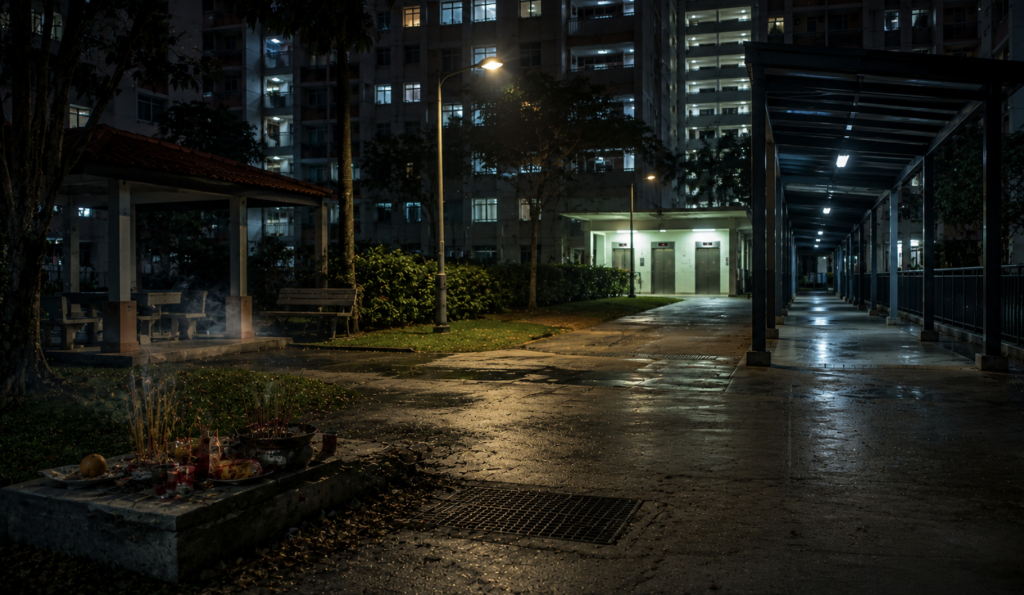
Folklore often begins not with what people see, but with what they cannot completely explain.
The Question That Remains
The delivery was completed.
The correct user received the package.
Nobody was hurt.
Nothing was lost.
There was no reason to return upstairs and investigate.
So the first apartment was never checked again.
Perhaps that was for the best.
Because even after discovering the other lift, one image remained difficult to forget.
Not the different corridor.
Not the illuminated neighbour’s doorway.
Not even the mysterious second Unit 123.
It was the first door.
The dark room behind it.
The silent ceiling fan.
The complete absence of movement.
And the moment after the knock—
when the wooden door slowly began opening.
No footsteps.
No voice.
Nobody visible.
Just a widening gap into a dark apartment.
Then it stopped.
Perhaps someone was standing behind it.
Perhaps it was only air pressure.
Perhaps the unit number was simply misread.
There is probably a completely ordinary explanation.
But during the Seventh Month, some people would offer one final piece of advice:
If you knock on the wrong door and something unseen appears to answer…
maybe you don’t need to find out who opened it.
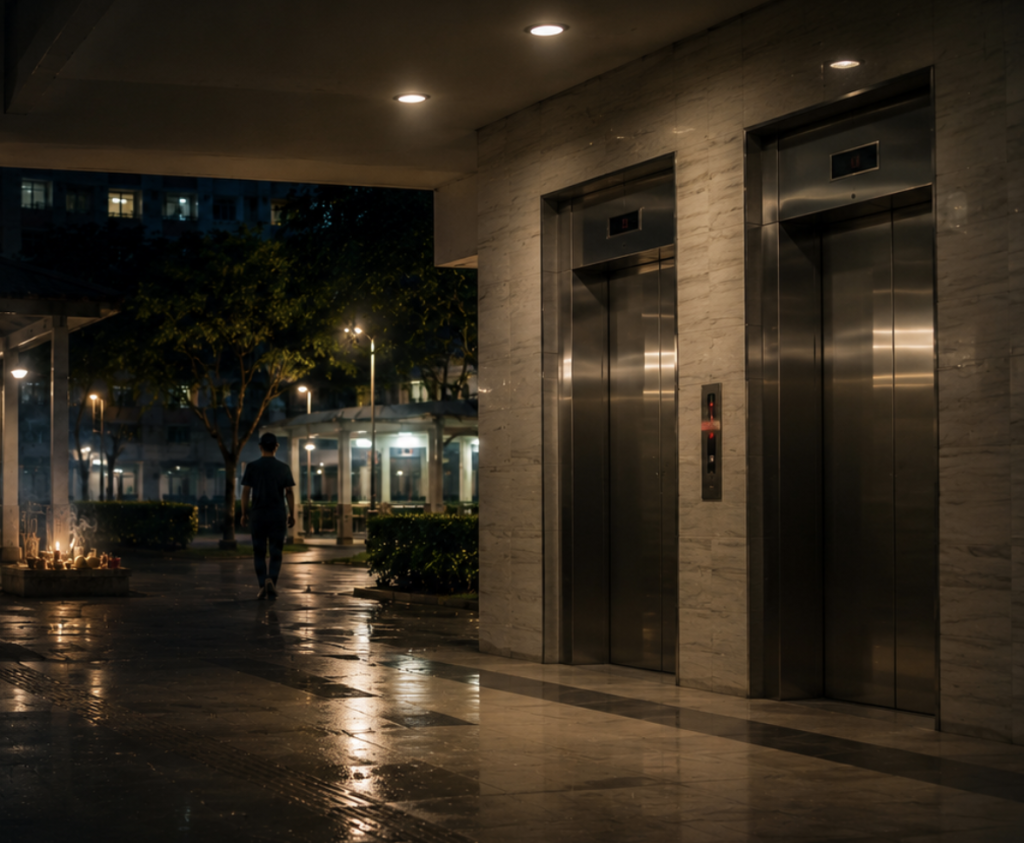
The delivery ended at Level 1. The unanswered part of the story remained upstairs
The Door on Level Five
The real Unit 123 was accessible from another lift.
So what was the first Unit 123?
And when nobody appeared to be there—
Who opened the door?
Some mysteries are frightening because we know what happened.
Others stay with us because we don’t.




Leave a Reply