
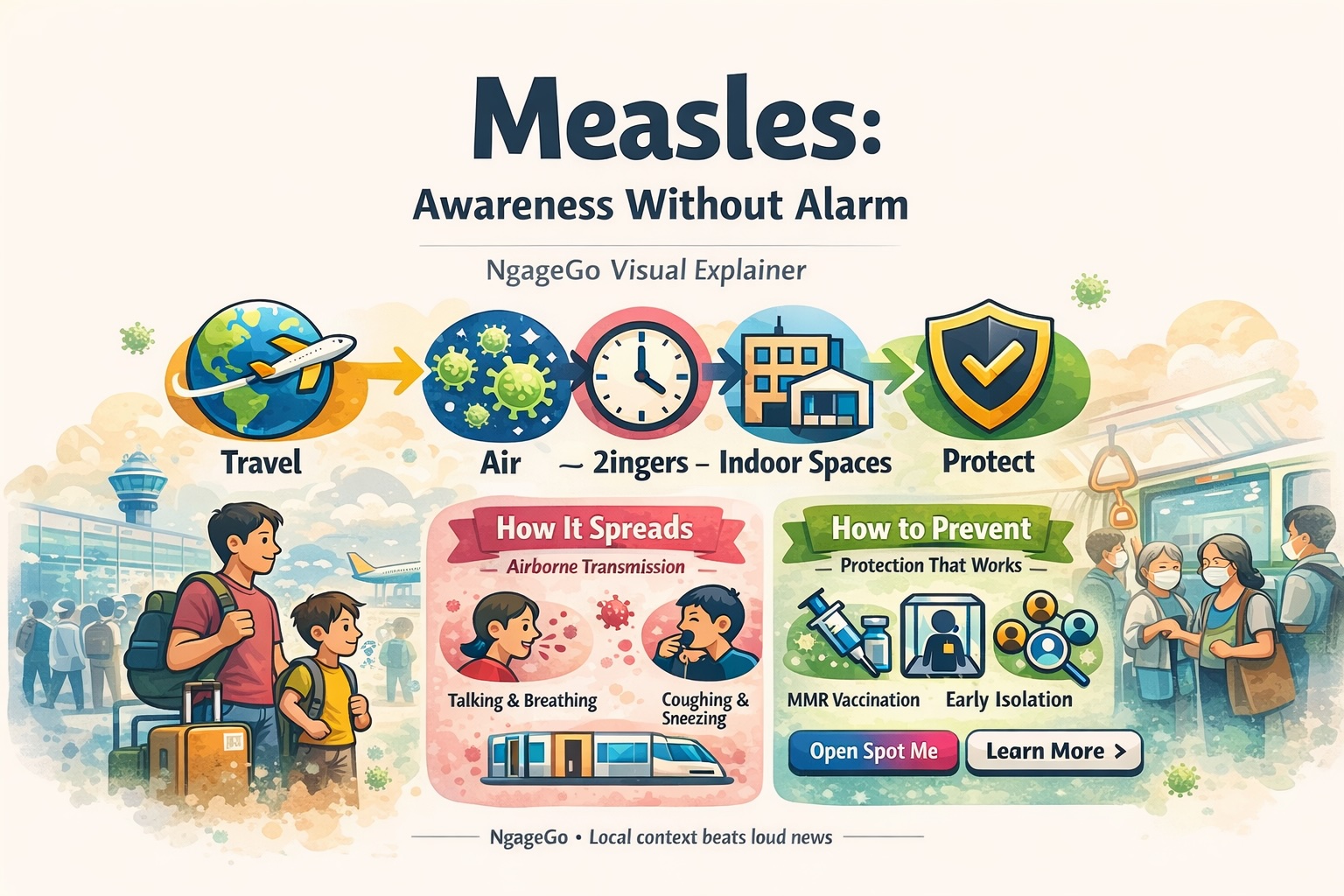
What the Measles Resurgence Means for Singapore
For most people in Singapore, measles feels distant — something associated with older generations or overseas outbreaks. Yet recent precautionary measures here are a reminder that even highly connected, well-vaccinated cities are not immune.
This isn’t about panic.
It’s about understanding how risk works in a city where movement is constant.
Measles doesn’t need chaos to spread. It only needs proximity.
Sources
- World Health Organization (WHO) – Measles (Fact Sheet)
- Channel NewsAsia – Singapore imposes mandatory isolation for measles cases; contact tracing after rise in cases
- The Straits Times – Singapore heightens precautions against measles amid global and local surge
Key facts at a glance
Cause: Measles is caused by a virus that infects the respiratory system.
How it spreads: Through airborne particles released when an infected person talks, coughs, sneezes, or breathes.
Contagiousness: One of the most contagious viruses known; spread can occur without direct contact.
Air survival: Virus particles can remain in the air for up to 2 hours, depending on ventilation.
Early symptoms: Fever, cough, runny nose, and red or watery eyes.
Rash: A distinctive skin rash usually appears a few days after early symptoms.
Prevention: Two-dose MMR vaccination and early isolation of confirmed cases are highly effective.
Why Singapore Is Paying Attention Again
Singapore’s situation mirrors what’s happening globally, but with a local twist.
As a major travel hub, Singapore sees:
- Heavy daily international arrivals
- Dense shared environments (public transport, malls, offices)
- Frequent large gatherings
- Close interaction across age groups
When measles appears anywhere in the region, it doesn’t stay regional for long. Cases are often linked to travel — and once introduced, the virus looks for enclosed, shared spaces.
That’s why authorities move quickly here, even when case numbers remain low.
How Measles Spreads in Everyday Singapore Spaces
Measles spreads through airborne particles, not touch.
An infected person can release virus particles simply by:
- Talking
- Coughing
- Sneezing
- Breathing in enclosed areas
One key detail matters especially in urban settings:
Measles particles can linger in the air for up to two hours after an infected person has left.
This means exposure can happen without direct contact — for example:
- Entering a lift, clinic, or classroom later
- Sitting in an MRT carriage after someone exits
- Waiting in an enclosed queue or waiting area
In a city built around shared infrastructure, timing and ventilation matter as much as distance.
( credit –CNA )
Why Outbreaks Can Still Happen Here
Singapore has strong vaccination coverage, but outbreaks don’t require widespread gaps — just small overlaps.
Common factors include:
- Infants too young to be fully vaccinated
- Adults who missed or delayed vaccination earlier in life
- Immunocompromised individuals
- Mild early symptoms mistaken for flu or allergies
By the time measles is identified, transmission may already have occurred in everyday spaces people don’t associate with risk.
What Prevention Looks Like in a Singapore Context
Prevention here isn’t dramatic — it’s practical.
Vaccination
The two-dose MMR vaccine remains the most effective protection, both individually and at the community level.
Early Isolation & Contact Tracing
Quick isolation and tracing are why Singapore often stops outbreaks early. Speed matters more than scale.
Awareness
Knowing how measles spreads helps people act sensibly:
- Seeking medical advice early
- Avoiding unnecessary exposure when unwell
Preparedness doesn’t disrupt daily life — it supports it.
A Quiet Reminder for a Fast-Moving City
Measles returning isn’t a step backward. It’s a reminder of how connected modern cities are.
The lesson isn’t fear.
It’s attentiveness.
In a place where people move quickly and share space constantly, protection depends not only distance — and more on readiness, clarity, and community awareness.
( credit – American Medical Association (AMA))




Leave a Reply