
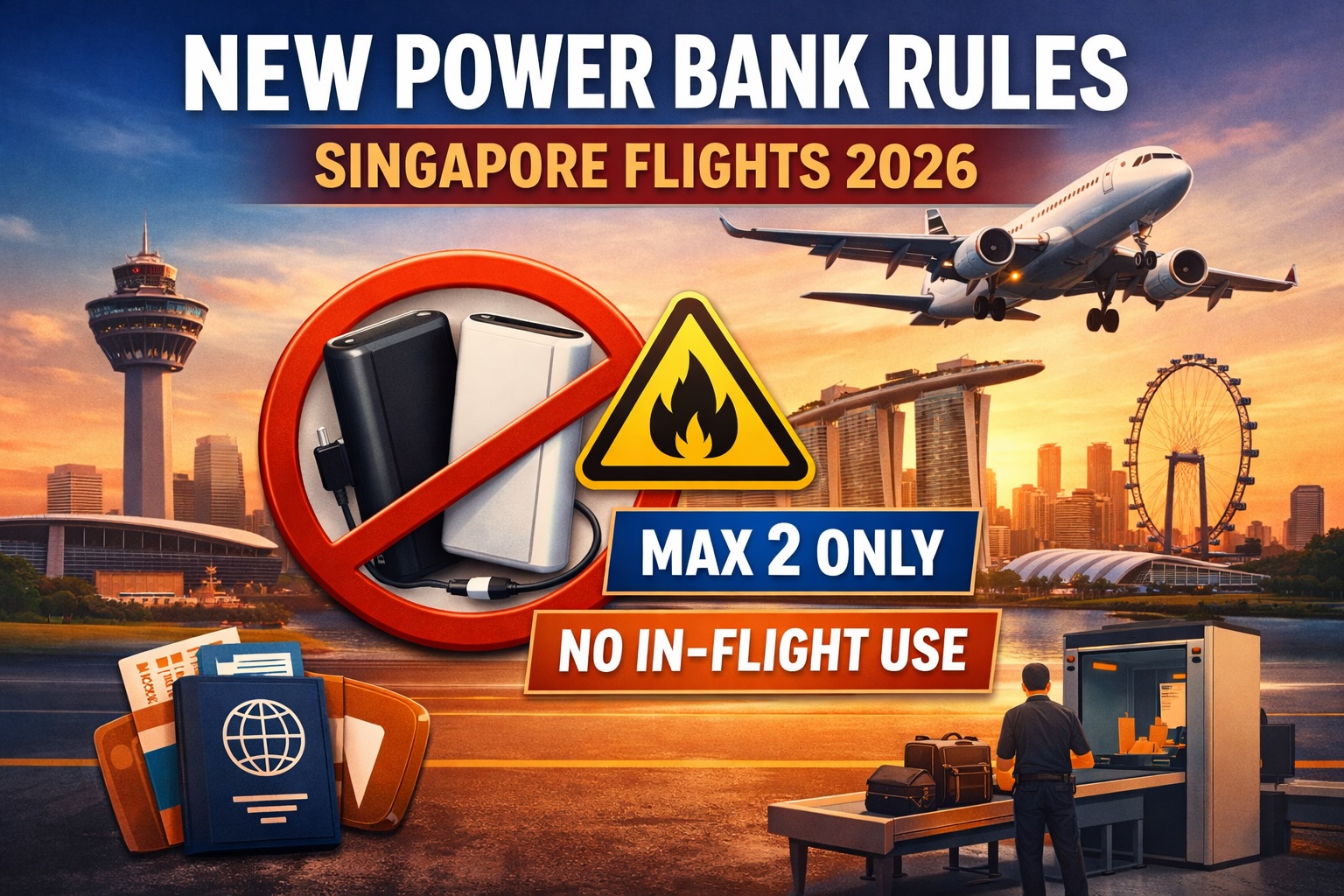
Power Bank Rule — Singapore Flights
A live timeline signal powered by NgageGo
There was a time when power banks were treated like any other travel accessory. You packed one, sometimes two, sometimes even more, just in case your phone ran out of battery mid-flight. They were small, portable, and largely unregulated in the eyes of everyday travellers.
That assumption is now changing.
✈️ What Has Changed
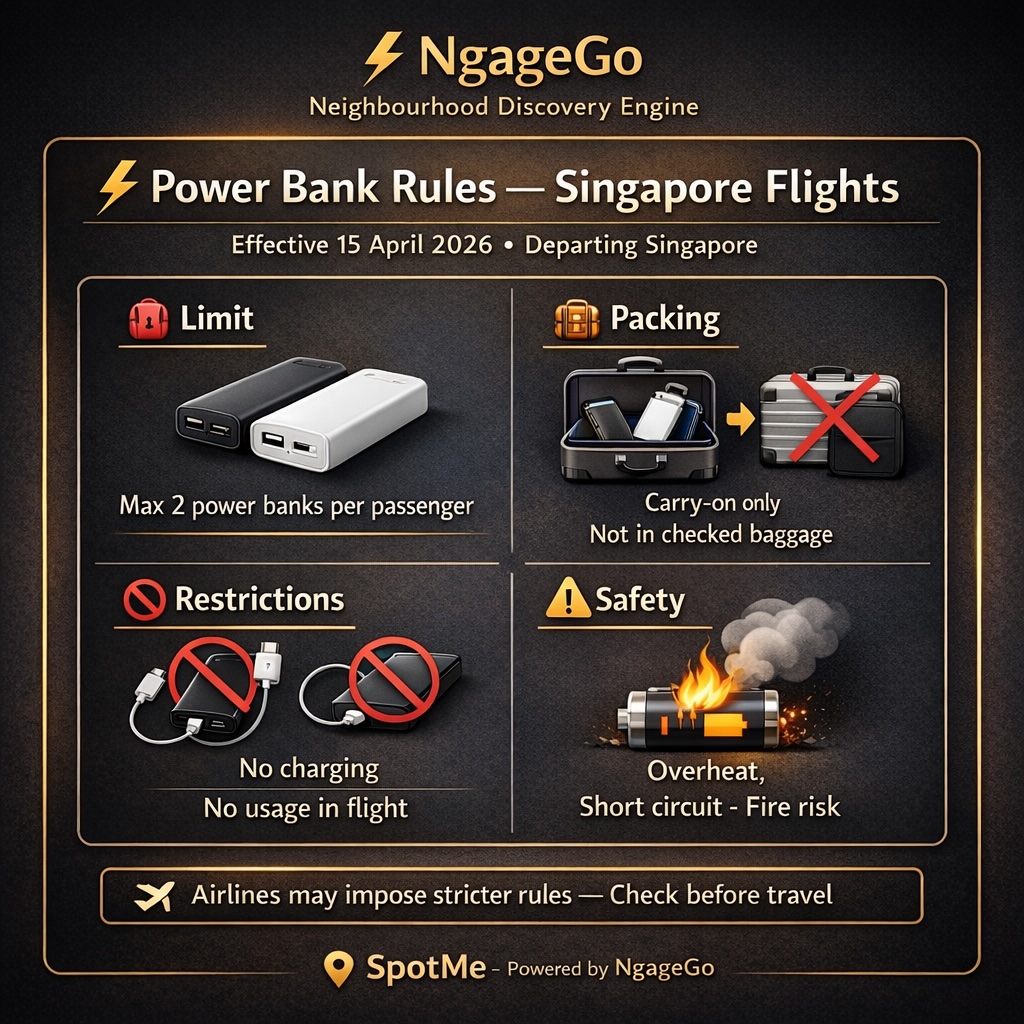
From 15 April 2026, passengers departing Singapore will be subject to a new aviation rule. Each traveller is allowed to carry a maximum of two power banks. Anything beyond that must be disposed of before boarding.
At the same time, the use and charging of power banks during flights are no longer permitted.
On the surface, this may seem like a minor adjustment. But in reality, it signals something much bigger — a shift in how everyday technology is treated in aviation environments.
🔋 Why Power Banks Are a Concern
Power banks are powered by lithium-ion batteries. These batteries are efficient, compact, and widely used across modern devices. But they also carry risks.
Under certain conditions, they can overheat, short-circuit, or even catch fire. In a controlled environment like a home or office, these risks are manageable. Inside an aircraft cabin, however, they become far more serious.
Aircraft cabins are enclosed spaces at altitude, where even a small fire can escalate quickly. This is why aviation authorities around the world have been gradually tightening rules around lithium batteries.
The new Singapore rule aligns with updated international safety guidance and reflects a growing global awareness of these risks.
⚖️ Why This Rule Is Different
What makes this change notable is not just the restriction itself, but how it simplifies enforcement.
Instead of relying on technical specifications or battery capacity limits that passengers may not fully understand, the rule is straightforward: no more than two power banks per person.
This clarity reduces ambiguity at security checkpoints and boarding gates.
🧳 What Travellers Need to Do
For travellers, the practical implications are simple but important.
Power banks must now be treated as regulated items. They must be packed in cabin baggage, not checked luggage. They should be protected from short circuits, meaning exposed terminals should be covered or stored properly.
During the flight, they should remain unused.
Some airlines had already begun implementing stricter policies even before this regulation. For example, bans on using or charging power banks during flights were already in place on certain carriers.
This new rule standardises expectations across all flights departing Singapore, while still allowing airlines to impose additional restrictions if needed.
🌍 A Wider Shift in Aviation Safety
This is part of a broader pattern in aviation. Items that were once considered harmless are now being reassessed through the lens of safety.
Just as liquids, sharp objects, and electronic devices have been regulated over time, portable battery packs are now entering that same category.
💡 What This Means for Everyday Travel
From a traveller’s perspective, this does not mean giving up convenience. Instead, it means planning more deliberately.
Bringing one or two reliable power banks is still allowed. Charging devices before boarding becomes more important. Airport charging stations and in-seat power outlets become part of the journey planning process.
From a wider perspective, this rule reflects how everyday habits are evolving alongside technology.
The more dependent we become on portable power, the more important it is to manage its risks in shared environments like aircraft cabins.
📍 SpotMe Perspective
📍 From SpotMe — Powered by NgageGo’s neighbourhood engine
Seen through the NgageGo lens, this is more than just a rule update. It is a “travel signal” — a real-world change that affects behaviour, movement, and preparation.
It connects airports, travellers, and everyday objects into a single evolving system of safety and awareness.
What used to be an afterthought — a power bank in your bag — is now part of a larger story about how modern travel adapts to modern technology.
And like many such changes, it may feel small at first. But over time, it reshapes how people move, prepare, and experience the journey itself.
SupportMe
Support this page if it helped you.




Leave a Reply