
Not Sure Where You Are?
From📍SpotMe
Powered by NgageGo’s neighbourhood engine.
Location access required. We’ll load your featured neighbourhoods.
Countdown automatically follows the festival period.
Stream uses privacy-enhanced mode (youtube-nocookie).
This is a featured area preview set by NgageGo. Your exact location isn’t shown — we only use it to estimate distance.
Your exact location isn’t shown — we only use it to estimate distance and show nearby GoXpots.
Chinese New Year (CNY), also known as the Spring Festival (春节), is the most important traditional celebration in Chinese culture. More than a date on the lunar calendar, it represents a carefully structured cultural system built on renewal, continuity, and reverence for ancestry. For centuries, the festival has functioned not merely as a holiday, but as a reaffirmation of values that shape family life and social order.
Unlike many modern holidays that emphasise leisure, Chinese New Year is rooted in ritual discipline and symbolic meaning. Even as lifestyles evolve and technology reshapes communication, the cultural architecture of the festival remains remarkably intact.
At its heart, CNY is about beginnings — and how one chooses to begin.
🌙 The Significance of a Lunar Beginning
The lunar calendar situates Chinese New Year within a cyclical understanding of time. Each year is not simply a continuation but a renewal — a moral and relational reset.
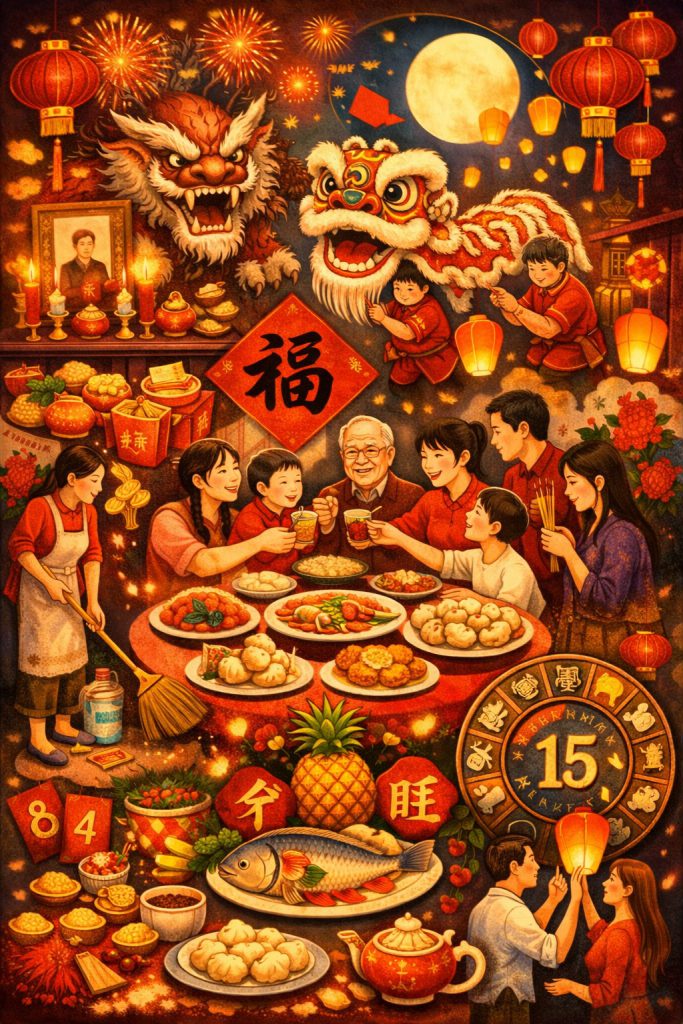
The period before the new year reflects this mindset. Homes are cleaned thoroughly to symbolise the removal of misfortune from the previous year. This cleansing is deliberate and time-bound. Once the new year begins, sweeping is traditionally avoided on the first day to prevent “sweeping away” newly arrived luck.
This careful treatment of beginnings reflects a worldview where timing, intention, and harmony are interconnected.
👨👩👧 Reunion as the Emotional Center
If renewal is the philosophical core of CNY, reunion is its emotional center.
The reunion dinner on the eve of the new year symbolises completeness. Family members travel long distances to gather, reinforcing filial piety (孝) — respect and responsibility toward elders.
Red packets are exchanged not merely as money, but as blessings. Generational hierarchy is acknowledged gently through greetings and well wishes. In the days that follow, families engage in New Year visiting (拜年), extending reunion beyond the immediate household and reaffirming extended kinship bonds.
The festival becomes a reaffirmation of belonging.
🏮 From Private Ritual to Public Celebration
While CNY begins in the home, it quickly extends into public space.
Lion dances animate neighbourhood streets. Lanterns illuminate commercial districts. Community performances transform tradition into collective spectacle. These events are not merely entertainment; they are symbolic expressions of courage, renewal, and the driving away of negativity.
To experience how these traditions unfold in real time, here are local livestreams capturing the atmosphere:
These streams reflect how tradition lives in modern form — blending ritual symbolism with contemporary staging, lighting, and broadcast technology.
The Language of Symbolism
Symbolism permeates the festival.
Red represents vitality and protection. Lanterns symbolise brightness and hope. Spring couplets (春联) express wishes for prosperity and harmony. The character “福” represents good fortune entering the home.
Food symbolism deepens this language of meaning. Fish represents surplus. Dumplings resemble ancient ingots and symbolise prosperity. Sweet desserts emphasise harmony and unity. These symbolic associations are sustained through repetition across generations.
Through shared language and imagery, culture becomes tangible.
🌏 A Global Festival
Chinese New Year has expanded beyond its historical origins, carried by migration and diaspora communities worldwide. While forms vary, the underlying values remain consistent: renewal, respect, harmony, and prosperity.
To see how this festival unfolds on a broader international stage, here is an overseas livestream:
This broader presentation illustrates how the festival adapts to modern performance formats while maintaining symbolic continuity.
🕯 Honouring Ancestry
Ancestral respect remains central to CNY. Families offer prayers or prepare symbolic offerings to honour those who came before them. This act reinforces lineage continuity — a reminder that identity extends beyond the present generation.
CNY binds past, present, and future within a single cultural frame.
🔴 A Festival of Continuity
Ultimately, Chinese New Year endures because it preserves continuity. It marks the transition between cycles while reinforcing stable values. It acknowledges family hierarchy while strengthening social cohesion.
While modern tools — livestreams, digital greetings, online broadcasts — extend the festival’s reach, they do not replace its essence. Instead, they reveal how tradition adapts without dissolving.
Chinese New Year is not simply a celebration of a new year.
It is a commitment to begin again — thoughtfully, respectfully, and together.




Leave a Reply