
🚀 Ever heard the universe whisper?
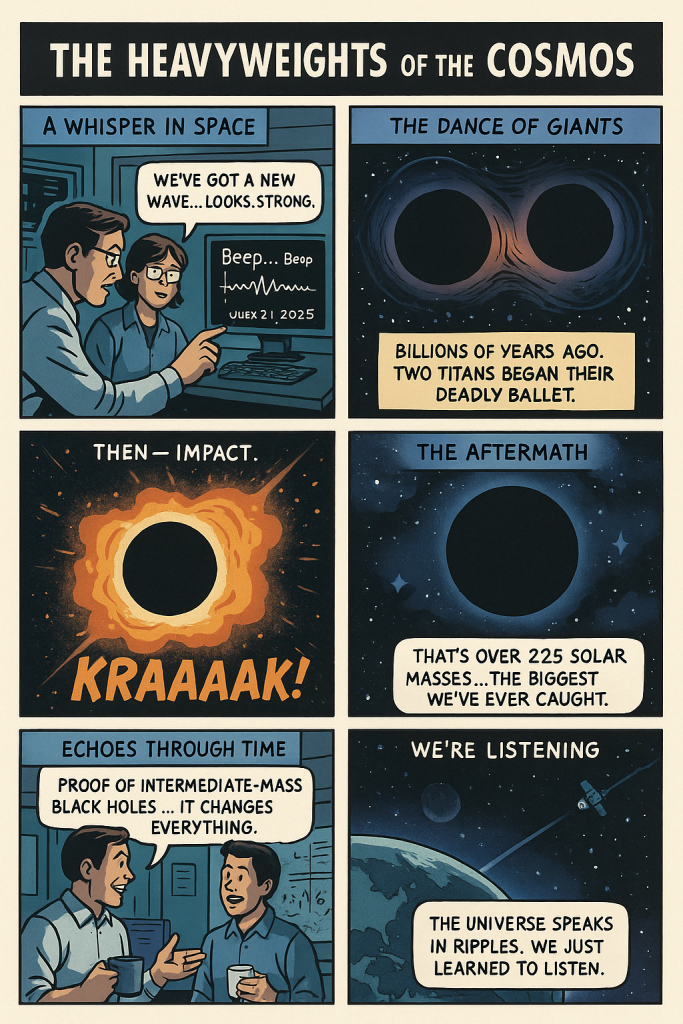
On July 21, 2025, scientists at the LIGO observatory picked up something extraordinary—a ripple in space-time so strong it made them sit up straight, coffee halfway to their mouths.
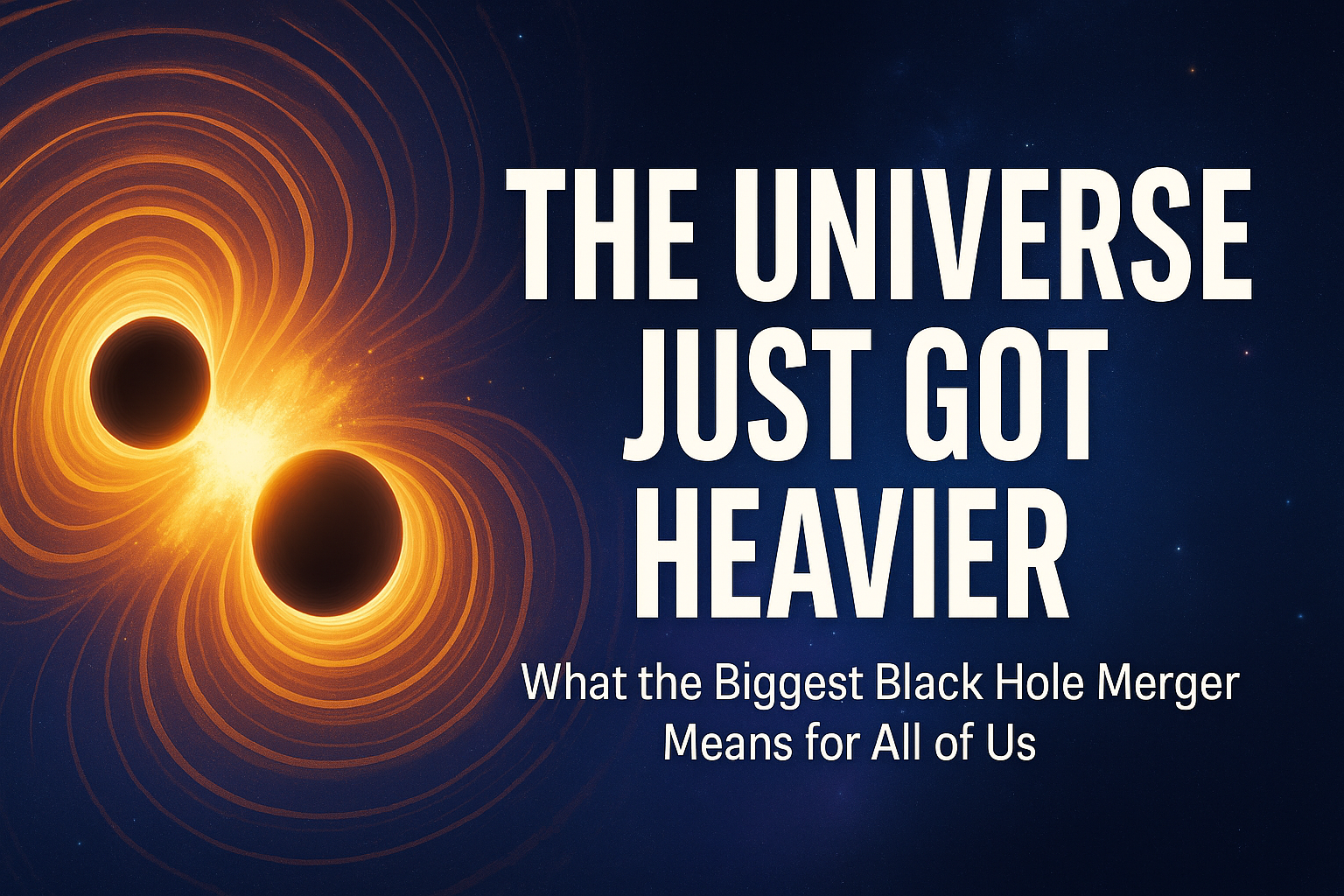
That ripple? It came from the most massive black hole merger ever recorded.
Imagine two titanic voids of gravity—each dozens of times more massive than our Sun—spiraling toward each other in a cosmic dance, colliding with such force that even light couldn’t escape. Now that kind of drama would make even your most chaotic group chat jealous.
Let’s break it down.
🌠 What Actually Happened?
LIGO (Laser Interferometer Gravitational-Wave Observatory) detected gravitational waves from a collision of two black holes that created one final black hole over 225 times the mass of our Sun.
This is the largest stellar-mass black hole merger ever detected—a milestone in modern astrophysics.
Here’s what makes it such a big deal:
- Gravitational waves are literal ripples in the fabric of space-time.
- This event proves the existence of intermediate-mass black holes, something astrophysicists have theorized but never confirmed with this kind of clarity.
- It happened billions of years ago, but the signals only reached Earth now—like a postcard from deep time.
🔭 Why Should You Care (Even If You’re Not an Astrophysicist)?
You might be thinking: “Cool… but what does this have to do with me?”
Actually, more than you’d expect:
- Proof that Einstein was right—again. His general theory of relativity predicted these waves a century ago.
- Technology spinoffs from gravitational wave research have already impacted everything from GPS precision to laser calibration in surgery.
- Perspective. It’s humbling (and oddly comforting) to know there are forces out there much larger than daily emails or traffic jams.
🌍 How Close Are We to Space Travel Now?
Not as close as sci-fi, but closer than ever:
- Events like this feed AI and quantum data models for deep space navigation.
- They’re paving the way for better space telescopes and even wormhole research (yep, it’s real science now).
- International collaborations like LIGO, Virgo, and KAGRA are uniting nations through science, not just economics.
📍 Nearest Neighbourhood to the “Universe”?
Well, not exactly Marina Bay or Tiong Bahru… but if you’re near Science Centre Singapore (15 Science Centre Rd, Singapore 609081), you might catch an exhibit soon explaining this black hole breakthrough.
Fun fact: There are VR shows right now that simulate gravitational waves—perfect weekend plan with the kids (or your inner nerd).
Final Thoughts: We’re Finally Listening
The universe has always been talking. We just started learning how to listen.
Moments like this remind us how interconnected everything is—even if it happened billions of years ago, the echo reaches us now. What a wild, beautiful thought.
💬 Your Turn!
What fascinates you most about space—black holes, time travel, or something else?
Drop your thoughts in the comments below. Let’s explore the cosmos together 🌌
👉 Subscribe at Ngagego.com and choose your nearest neighbourhood to leave a mark on the stars—bookmark this journey!
⚠️ Disclaimer:
Information is based on live astronomical findings and may be updated as new data is confirmed. Exhibits or shops at Science Centre Singapore may change—please check official website before visiting.
Remember: You’re made of stardust. Literally.




Leave a Reply